
Pain is Information
Adaptive Bodywork and pain management through increasing window of tolerance for misery

This post is for John Sutherland and Adaptive Bodywork in Montreal. Thanks, John.
Among the basic principles of somatics are these: it is rational to protect yourself. If someone raises their hand to strike you, you flinch. This is a kind of wisdom.
I am always in pain. It’s always been this way. My body is also a seat of incredible pleasure. My pain levels are usually somewhere between a 3 and a 7. I don’t know when I started dealing with it by retreating into my head. I was always clumsy. Injury-prone. I was a toe-walker, when I was a little kid — always craned up, and forwards. There are echoes of this, in my woman-body: my calves knotted like old oak trees, pale and ungenerous in the way they let blood in and out. My shoulders close off my heart to things that might threaten my peace, like difference, or joy. Despite hours in paid therapy, or being given attention by well-meaning lovers, I do not trust my stomach. It is unserious and lazy. It is soft as a spoiled child.
The typical physical activities of childhood wrecked me. I sprained my ankles descending from street curbs, bruised and dislocated things climbing and throwing, was jostled to spasm by hockey skates or a pirouette. It is rational to protect yourself. I had other skills: no one had to teach me to read, I taught myself, noting the correlations between my parents’ voice and the black marks on the pages of the books they read to my sister and I. They read to us with the kind of loving, dedicated work ethic required of successful professional artists. One day, the symbols cracked open, and with them a thousand different worlds. I could get to them while lying completely still. I could get to them without hurting myself.
I was sixteen when I walked into a gym, in the small town where I spent most of my childhood, to meet my father after a workout. One of the trainers remarked to him, after, that they’d never seen spinal degeneration so severe on a person so young. The spinal disfigurement I’d developed is sometimes called scholar’s posture, which is the only kind name for it — all of the other names are cruel, the kind of thing that strike an embodied sense of panic and hideousness into a sixteen year-old girl. Among them: dowager’s hump. I had a university reading level and the face of a child. I had the spine of an old woman.
My metaphysics is one of scientific realism. I have a felt sense of the existence, inside of me, of something like a soul. I lived many years of my life trying to act like there was a distinct difference between my body and my mind, and since my mind was the seat of less pain — or, at least, pain I found less threatening — then that was the real me, and my body was something I simply piloted around. Teaching myself to stand up straight, which I have been doing in fits and starts, between long periods of neglect, since that day I was sixteen — this has taught me that my mind-body conceptualization, these two solitudes of being, is a fiction. They are exactly the same thing. I am all of me. To find peace in one thing, I have to make peace with the rest of it.
This lead me to structural integration, with John Sutherland, at his studio in Montreal. John is a jock. I am a nerd. Being the best jock he can be has lead John to becoming something of a nerd. In order to sustainably nerd out, I must also become something of a jock. On this level, we understand each other.
He had me on my back, in my bra and underwear, grinding his fingers into the notch of my hip joint, my voice filling his loft space with bleats of agony, when he told me that I would make a great attendee at one of his workshops.
“Oh?” I asked, when he backed off, and the pain was immediately replaced — as it always was with John — with cordial and professional friendliness.
“You’re very good at communicating about what you’re feeling,” he said. “Which is important, for this kind of work.”
I was going to find out what he meant.
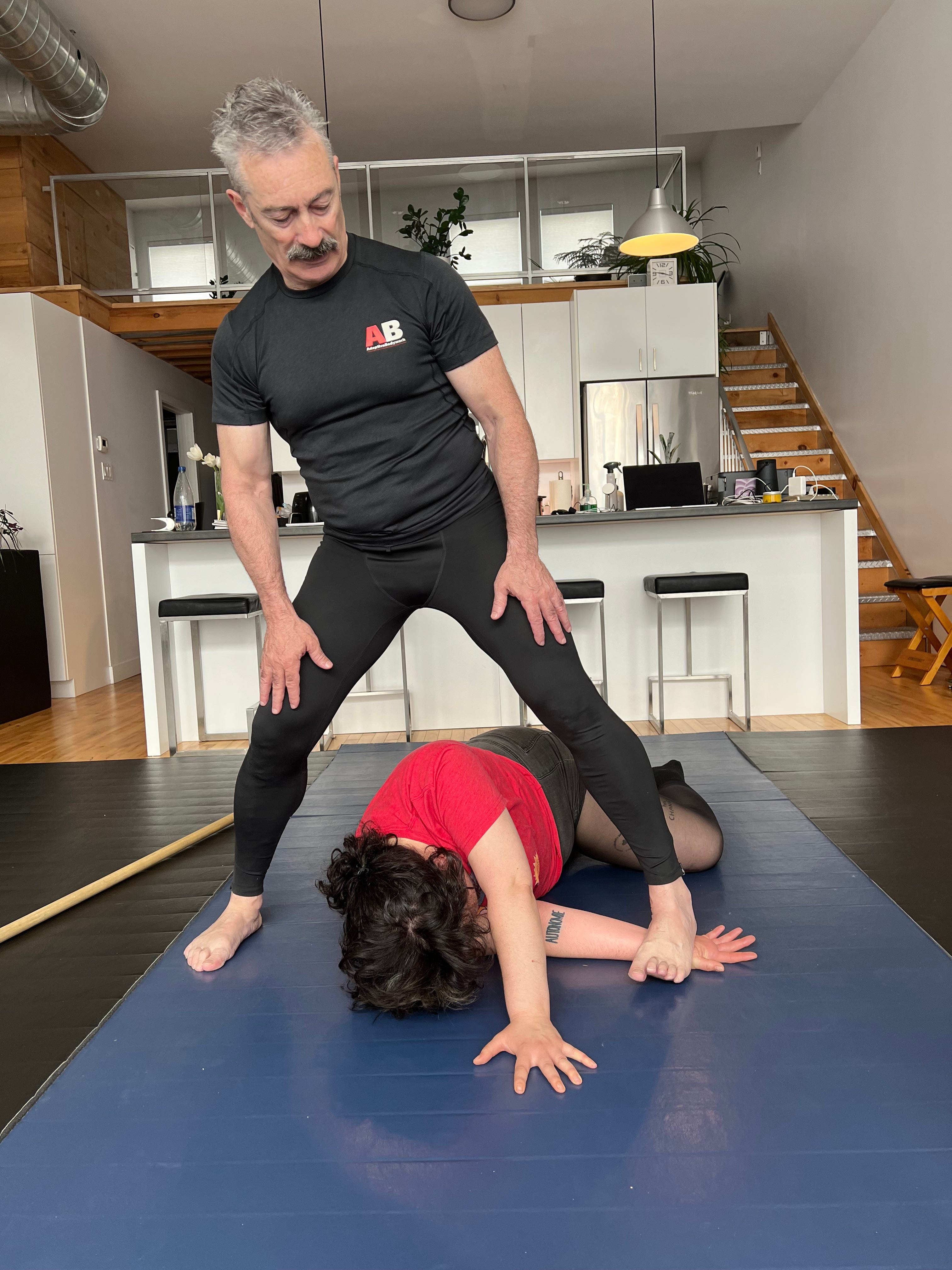
The workshop was small — just me and one other woman. It was a unit I certification for the adaptive bodywork methodology of this kind of bodywork. This methodology uses props and bodyweight in order to reduce strain on the practitioner. This also allows for a large range of pressure to be applied to the fascial system — from very gentle to the full force of the practitioner’s weight. The workshop was two full days, and targeted pretty much every major muscle system in the body.
The first day was all lower-body — starting from the ground and making its way up. Given how small the workshop was, we could focus on our individual needs and pain — which is lucky, for me, considering how many needs I have, and how much pain I have. Among my lower body’s defects: chronically inflamed ankles. My short, tender achilles tendons. The oaklike calves I mentioned earlier. And then there are the short hamstrings, knotted quads, the lymph that tends to pool in my inner thighs. My hips don’t usually hurt. They don’t usually feel very much at all.
I won’t bog you down with too many details. There’s enough to talk about in the first day, so I’ll leave out the second, for now. I’ll tell you that we stood on blocks, braced ourselves on chairs, learned to support ourselves with sticks, like stilt-walkers. We learned how to carefully transfer increments of weight over onto the trusting bodies of our workshop partners. We learned to keep in constant communication. We felt out with the bottoms of our bare feet for the ridges of each others muscles, learning things about each other, by communicating. There was the talking, of course — but talking isn’t the only way we communicate.
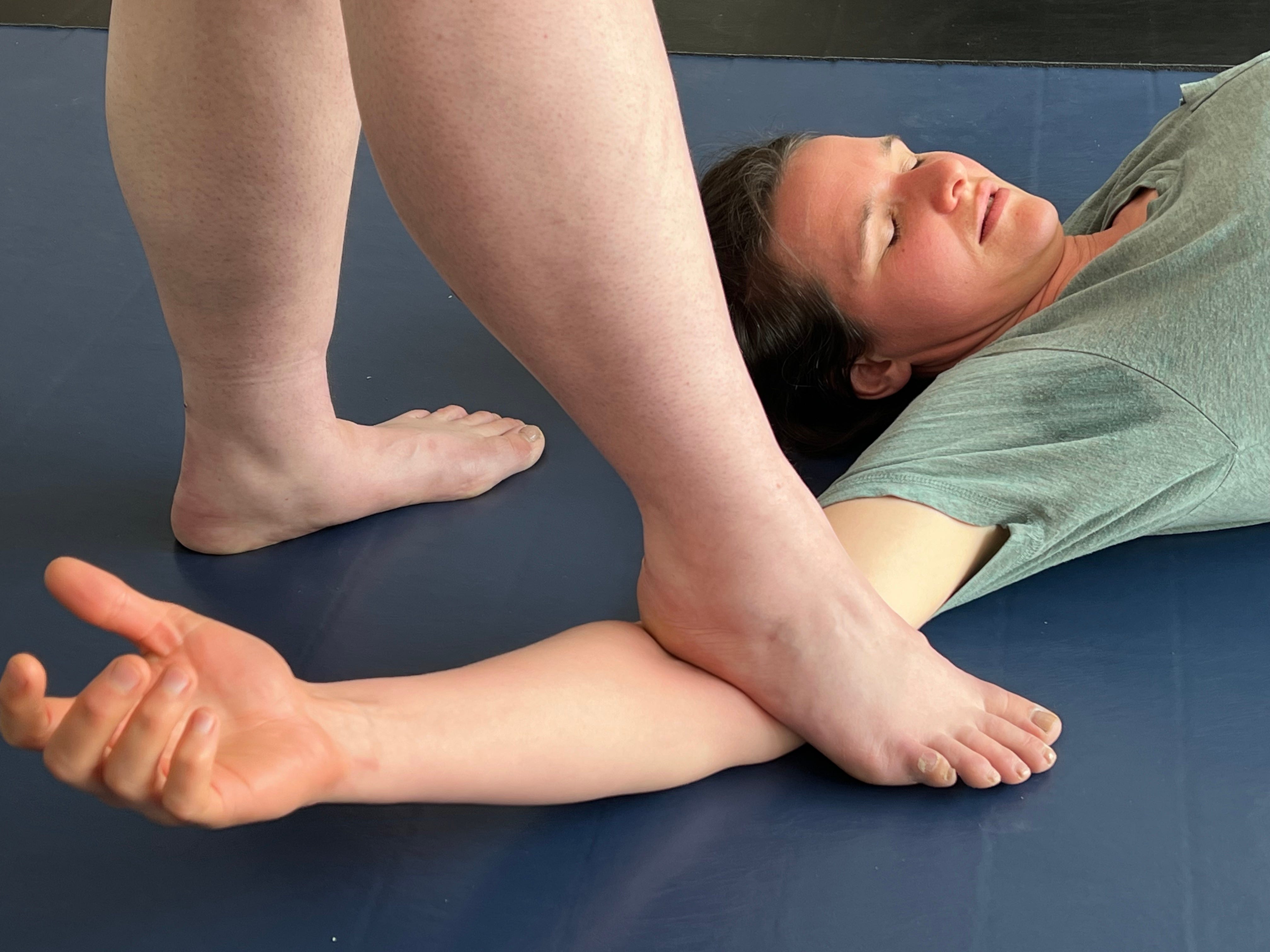
I’ve been thinking a lot about what muscle tension feels like, and how I can tell when I touch it, but not always because the muscle has a different give when I press than a muscle where blood is flowing easily. It’s more like I can feel a ghost hammering at the edge of my skin. I can feel anger, or sadness, or fear. I’m not an expert, and every body is different — but the longer you get to touch someone, the more their body will say things. The body and mind are exactly the same thing. So are words and touch.
When it was time to work on my hips, I was not prepared. I could not have been. The only way I can really talk about it is to say that I read a book once that described detoxing off of heroin — how taking opiates is like feeling every good and happy feeling you’ve ever felt in your life, all at once, and with the volume turned all the way up. Which means that detoxing is the opposite: every anxiety, every fear, every profound disappointment. Every sense that things would not be okay. All at once, and way too loud. No wonder people don’t want to get clean.
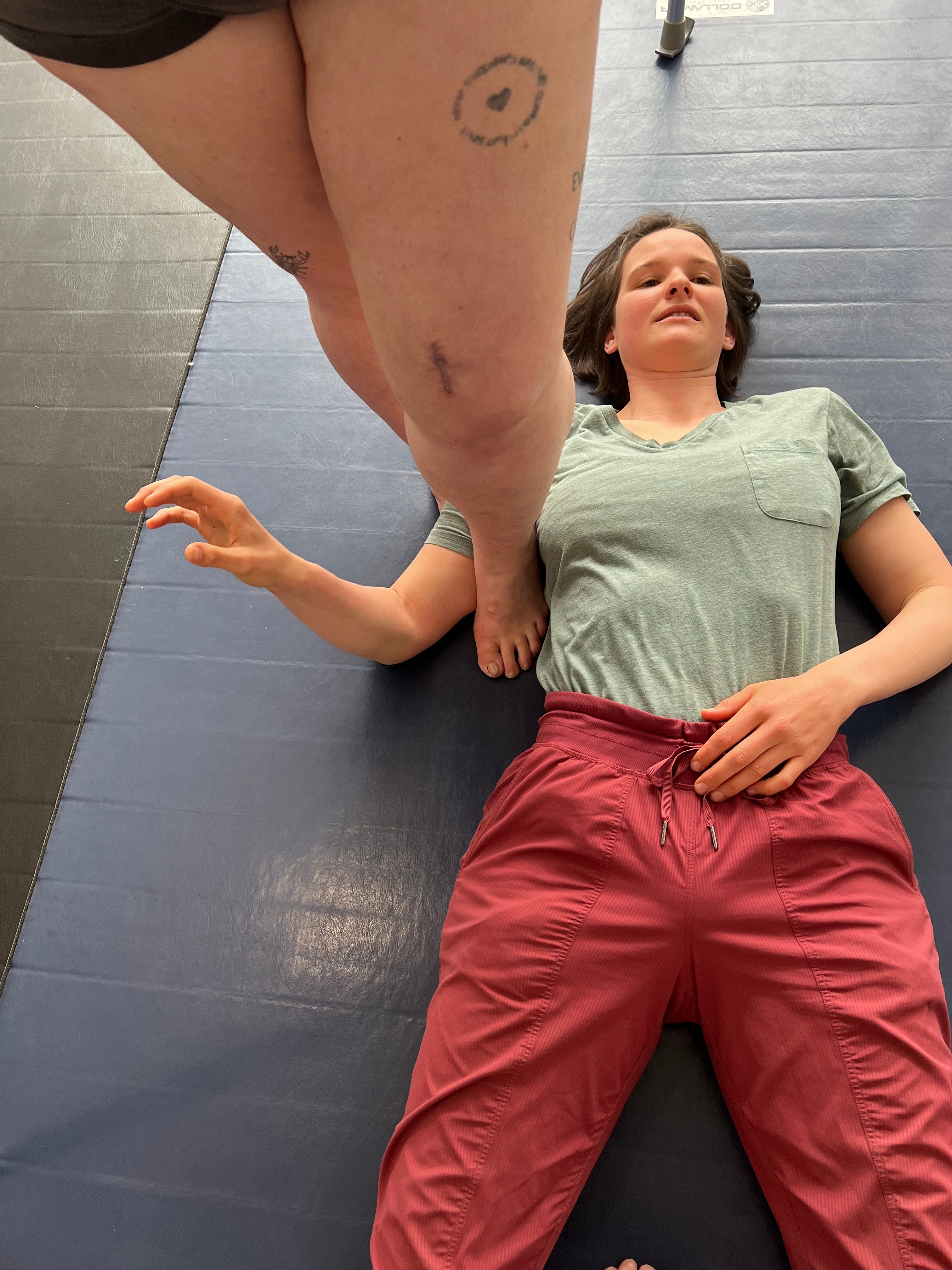
It took a minute for my hips to really warm up — talking to my workshop partner, asking her to back off and then come back, reposition her foot, and so on. My hips were offline. They didn’t want to talk. Then, a feeling started to bloom.
A basic principle of somatics: someone raises their hand to strike you, and you will flinch. It is rational to protect yourself. If something happens that you don’t like, your body responds. Your body develops a habit of responding. Your body and mind are the same thing. If the feeling is so big that it causes your mind to become overwhelmed, the mind will dissociate, and the body will take over. This is the body protecting you. It is rational to protect yourself.
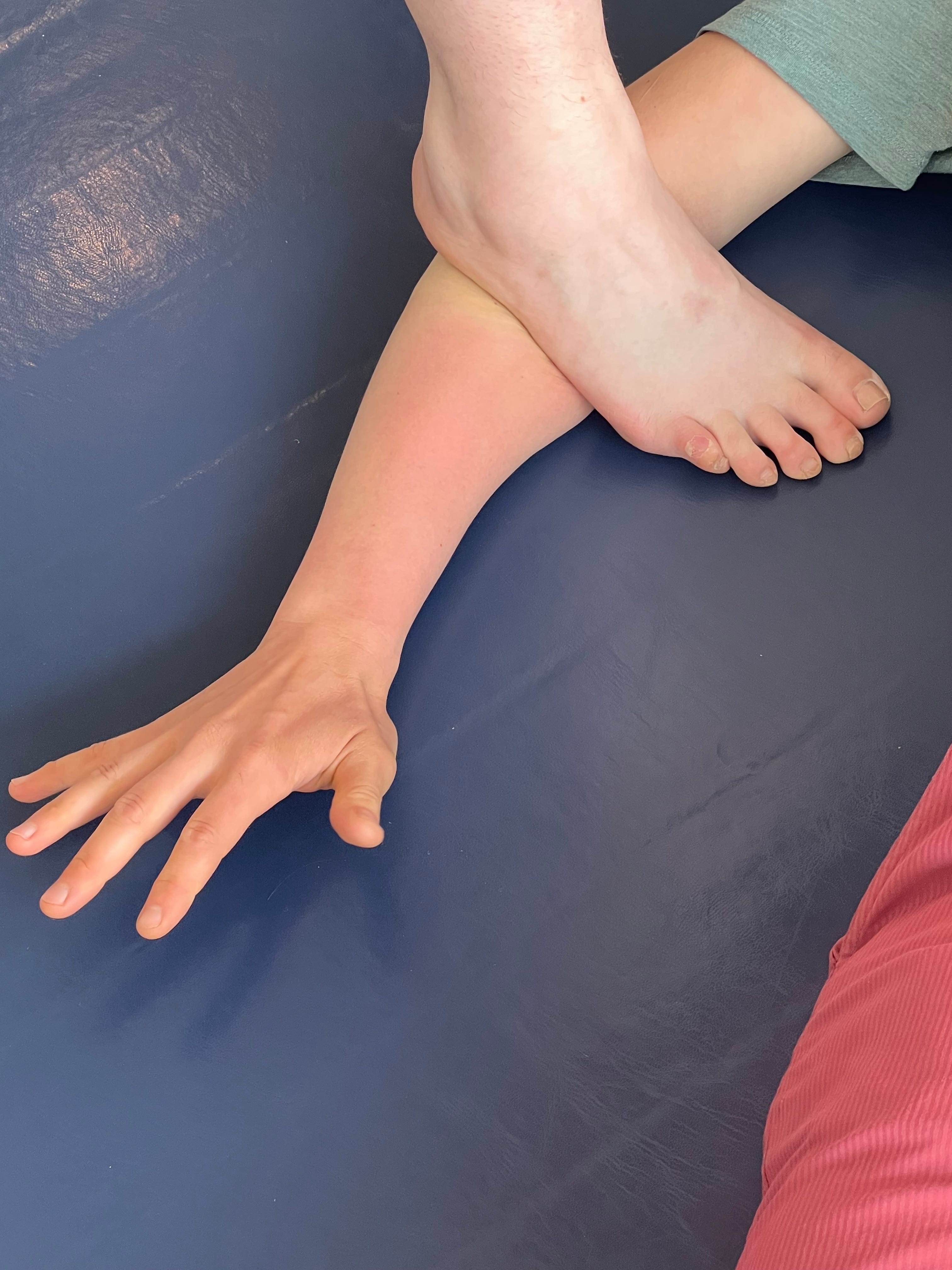
The feeling that flooded the rest of me, when my hips started to let go, was helplessness. Helplessness, in every way, and all at once. I felt like a little girl whose body wouldn’t stop breaking, doing normal little girl things. I felt like a bullied kid on a school yard. I was a hot-faced nine year-old contorted with a grief that smashed the world into pieces around me, because my mother was dead and God wouldn’t give her back to me, and I didn’t want to know that was possible. I was back in my fresh grief, like I had been when my mother died or my brother did, listening to well-meaning idiots talk about what they did to bring it upon themselves, knowing these well-meaning idiots were bargaining with their own mortality, knowing they were just afraid that the Bad Thing can happen to any well-meaning idiot at any time, knowing they would never listen to me. I was asking the guy I liked so much to slow down because he was hurting me while he didn’t slow down and kept hurting me. I was a smart girl having to listen to dumb men explain things because if I don’t they might kill me. I was supposed to know something and I didn’t know it. I was beaten. I was exhausted and out of water and miles from home. Strangest: I was drowning. My nose burning with salt. No idea which way is up. Suspended and breathless and the bad thing that could happen is happening like I have known it can since I was a little girl and there is nothing I can do nothing to do nothing nothing nothing nothing
I felt the hands stroking my hair before I noticed I was crying. When the pressure eased off, the room came back into focus. Blood bloomed in my pelvis like it hadn’t been. Like I hadn’t noticed it hadn’t been, because it hadn’t been for so long. I wiped my face. I drank water. We finished the workshop.
I’d done three months of one-on-one bodywork with John, in addition to this workshop, when I left for California in June. Over the course of the next three months, my body completely changed shape. My pain isn’t gone, but it’s different.
This is also different: now, when I am moving through the world, and something happens, sometimes I feel a familiar flinch in my hips.
Now I know what it means.